
Introduction to V.34 High-Speed Fax
This white paper discusses the unique features of the V.34 facsimile standard, which delivers higher performance and reliability, and how the rapid adoption of high-speed fax results in increased economy and efficiency for businesses.
With advancement in facsimile technology, enterprises face the decision to upgrade their fax solutions to high-speed fax, namely V.34. Dubbed “V.Fast”, the V.34 fax standard is a significant enhancement in fax technology with many advantages over legacy fax solutions. The adoption of the V.34 standard allows:
- Data rate of up to 33.6Kbps, more than twice the speed of its predecessor, V.17 (14.4Kbps)
- Support for fast handshaking, which cuts session setup and management time significantly over legacy solutions
- High-speed transmission enables transport of colour fax data
In addition, fax devices supporting V.34 offer more robust and reliable fax transmissions for varied line conditions as a result of the mandatory ECM protocol and the more sophisticated modulation/demodulation scheme. These improvements result in cost savings from reduced fax phone bills especially for long-distance scenarios.
The ITU-T V.34 Fax Standard
The V.34 fax standard was derived from the V.34 data modem standard established by the International Telecommunications Union (ITU). The V.34 data modem standard is a full-duplex implementation for sending and receiving data across telephone lines with a maximum data rate of 33.6Kbps. Certain elements of the V.34 data modem standard were eliminated for V.34 fax while new features, such as a control channel and mandatory ECM, were added to enable fast and reliable fax transmission.
The V.34 Fax Connection and Session
In order to understand the benefits of the V.34 fax standard, it is first necessary to understand how a fax transmission works. V.34 session management and setup were designed with a similar mechanism to legacy handshaking procedures. The first step of a fax session is to establish a ‘handshake’ between the sending and the receiving devices. During handshaking, the sending and receiving devices negotiate key parameters for how the fax call should be set up such as determining what is the highest transmission speed supported by both devices. The handshaking process itself is performed at 300bps in legacy devices. In V.34 fax capable devices, handshaking is performed at a much faster data rate of 1.2Kbps. The result is a handshake time that is reduced from approximately 16 seconds of legacy systems to 9 seconds for V.34.
| Data Rates Supported (Kbps) |
ITU Standard | ||
| V.27 V.29 |
V.17 | V.34 | |
| 2.4 | X | X | |
| 4.8 | X | X | |
| 7.2 | X | X | X |
| 9.6 | X | X | X |
| 12 | X | X | |
| 14.4 | X | X | |
| 16.8 | X | ||
| 19.2 | X | ||
| 21.6 | X | ||
| 24 | X | ||
| 26.4 | X | ||
| 28.8 | X | ||
| 31.2 | X | ||
| 33.6 | X | ||
The V.34 Fax Connection and Session
In order to understand the benefits of the V.34 fax standard, it is first necessary to understand how a fax transmission works. V.34 session management and setup were designed with a similar mechanism to legacy handshaking procedures. The first step of a fax session is to establish a “handshake” between the sending and the receiving devices. During handshaking, the sending and receiving devices negotiate key parameters for how the fax call should be set up such as determining what is the highest transmission speed supported by both devices. The handshaking process itself is performed at 300bps in legacy devices. In V.34 fax capable devices, handshaking is performed at a much faster data rate of 1.2Kbps. The result is a handshake time that is reduced from approximately 16 seconds of legacy systems to 9 seconds for V.34.
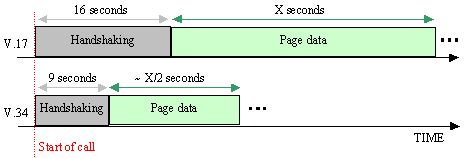
After handshaking is complete, the next stage of a fax session is the transmission of the actual fax page data. The retraining and re-synchronization process takes place after each page is transmitted in legacy schemes, where capabilities such as supported modulation and transfer are renegotiated. In case of error in the transmission, entire pages may need to be retransmitted. This cycle of page data retrain and retransmit repeats until the fax call is completed, and account for significant inefficiency of legacy fax machines. V.34 provides the most extensive range of supported data transmission rates, allowing it to optimize both speed and reliability over a wide range of line conditions. With V.34, fax page data is transmitted at 33.6Kbps, twice the speed of V.17. In addition, V.34 uses ECM (Error Correction Mode) as a mandatory feature that handles page transmission error in a much more efficient way.
ECM as a Mandatory Feature
ECM is a mandatory feature for V.34 fax as opposed to V.17, where it is optional. The ECM protocol was designed to automatically detect and correct errors in the fax transmission process caused by factors such as telephone line noise. The page data to be transferred is divided into small blocks of data called Octets. Once all octets are received, they are examined using check-sums.
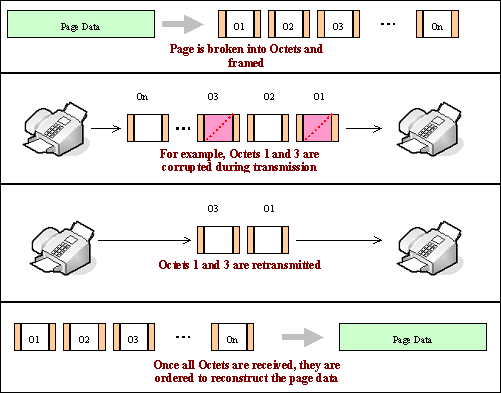
If any errors in the checksums are detected, the receiving fax device signals the transmitting fax device to retransmit the octets that were received incorrectly. The transmitter then retransmits only the needed blocks rather than the whole page. Once, all octets are received correctly, they are ordered and the page data is reconstructed by removing the octet frame and signaling flags. Generally, this results in a faster and more successful fax transmission than in a scenario where entire page data is retransmitted once or multiple times.
Market & Opportunities for V.34 Fax Solutions
Growth of V.34 fax machine shipments has been significant over the past several years. Figure 4 shows that sales of V.34 fax machines in 2001 totaled 1,080,600 units and grew to just over 4,000,000 units by 2005 with a compounded annual growth rate (CAGR) of 40%. The primary driving factor for this high growth is the sales of inexpensive laser and inkjet fax machines that are V.34 fax enabled. Currently, 60% of all laser fax machines and 25% of inkjet models sold are V.34 enabled. By 2005, 75% of all laser fax machines and 50% of all inkjet fax machines sold were V.34 enabled. Of the 6.3 million laser and inkjet fax machines sold in 2005, 4.2 million, or 66%, were V.34 enabled. By 2005, the general installed base of V.34 fax machines grew to 12%. In the corporate world, V.34 fax machine penetration will grow to a staggering 36%.
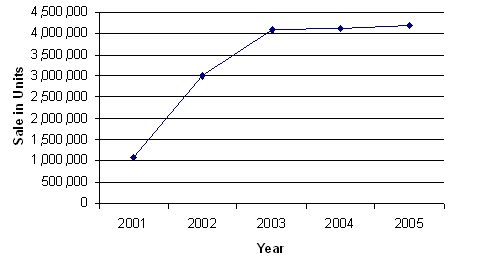
The net result of this analysis is that the installed base of V.34 fax machines is increasing and adoption is becoming widespread. As a result of the growth, users of V.34 fax will experience greater cost savings.
Further Stimulating Demand for V.34 Fax
Although V.34 is a highly beneficial solution for business, stimulating demand for V.34 fax can further increase the growth rate dramatically. Buyers are reluctant to upgrade to a V.34 enabled fax machines or MFPs due to the associated cost. In addition to being a newer technology, for which the market is still to grow enormously, businesses realize that it may not be profitable to switch to V.34 solution since it is not as popular yet. For instance, a buyer may assume that since V.34 enabled machines are generally more expensive, other businesses may not have upgraded to a similar solution, which would mean that the V.34 functionality of the machine may not be used as frequently. This reluctance would further add to decrease in demand of the product. A meaningful reduction in price is necessary in order to stimulate demand for V.34 enabled machines. This is only possible by reducing the per-manufacturing costs of the product.
V.34 fax software has adaptive bandwidth and carrier frequencies as compared to low speed fax software. V.34 fax software includes Trellis coding and shell mapping, which, on impaired channels, makes V.34 fax more robust.
V.34 fax standard is an important advancement in facsimile technology. It sends fax data at more than twice the speed of V.17 (14.4 Kbps) and supports fast handshaking, which can cut call-setup and session management time. Fax machines that support the V.34 (33.6Kbps) standard also deliver more reliable fax transmission with less resends due to transmission error, and can operate under a wider range of line conditions than those that only support V.17, V.29 (9.6 Kbps) and V.27ter (4.8 Kbps).
Capturing the V.34 Market
Disadvantages of using Fax Chipsets
A chipset is a group of integrated circuits that are designed to work together in performing one or more related functions, and are usually marketed as a single product. Traditional fax modem chipsets require a host processor, which itself may require a separate crystal as its clock, external memory, and other discrete electronic components. Additional circuitry will be required between these extra components. A hardware interface will also need to be designed to interface the modem chipset with the host processor. Each of these components takes up valuable space on the PCB, add to the overall weight, draw additional power and emit heat, and most importantly, they add to the overall cost. By using a chipset for fax functions, the host processor is not being utilized efficiently. Modern processors can handle multiple tasks concurrently such as running a fax modem data-pump while simultaneously driving other features of the end device. This eliminates the need for additional hardware components to provide fax functions and presents obvious advantages of a smaller PCB footprint, lower weight, and lower power consumption.
The Software Advantage
GAO Fax Modem solution is more economical, flexible and reliable than conventional chipsets. Software as well as chipset solutions are generally designed to be compliant to a specific ITU-T standard, and yield comparable reliability and quality. The advantage of GAO software is that it is intended to run on a DSP or processor along with other control software and only needs an analog front-end. In contrast, a chipset translates into additional hardware, which translates to an increased per-unit cost and amounts to significant accumulated overhead.
GAO software solution provides flexibility in accommodating the ever-evolving communications standards, changing command interfaces, the need for improved support and services, and the integration of data, fax, and voice related applications. This is not possible in a chipset solution other than upgrading the hardware, which would have a significant cost associated with it.
Capturing Market Opportunity with GAO V.34 Software-Fax
GAO V.34 fax implements a half-duplex mode of operation of the ITU-T V.34 recommendation, it supports data rates of 33.6Kbps down to 2.4Kbps. The modulation scheme is also suited for transmission of color images. The V.34 fax modem software has adaptive bandwidth and carrier frequencies as compared to legacy schemes, and includes Trellis coding and shell mapping, and on the impaired channels, this makes the V34 fax modem more robust. GAO V.34 fax can be combined with other fall back fax modems V.17, V.29, V.27ter and V.21ch.2 for interoperability with legacy equipment.
Modular and Optimized For Embedded Applications
GAO抯 software solutions are modular, re-locatable and reentrant to support multi-channel capability, and are optimized for all common embedded hardware platforms. By reducing the processing and memory requirements of a process intensive fax scheme like V.34, more features can be implemented on a less powerful processor. GAO code is highly modular allowing for flexibility in customizing the desired capabilities. For example, extra modulation capabilities, and telephony features can be added to higher-end systems, or a reduced modem set can be chosen for a smaller memory footprint on lower-end systems.
Versatility and Interoperability
GAO V.34 solution can operate within a multi-tasking environment or as a stand-alone task, and is optimized for fixed-point arithmetic. GAO V.34 Fax solution supports most of the commercial analog front ends (AFE) as well as various discrete DAAs with codecs, depending upon the application. GAO V.34 Fax Modem software can be integrated with other GAO data modems, telephony, speech compression, and fax relay solution for various applications.